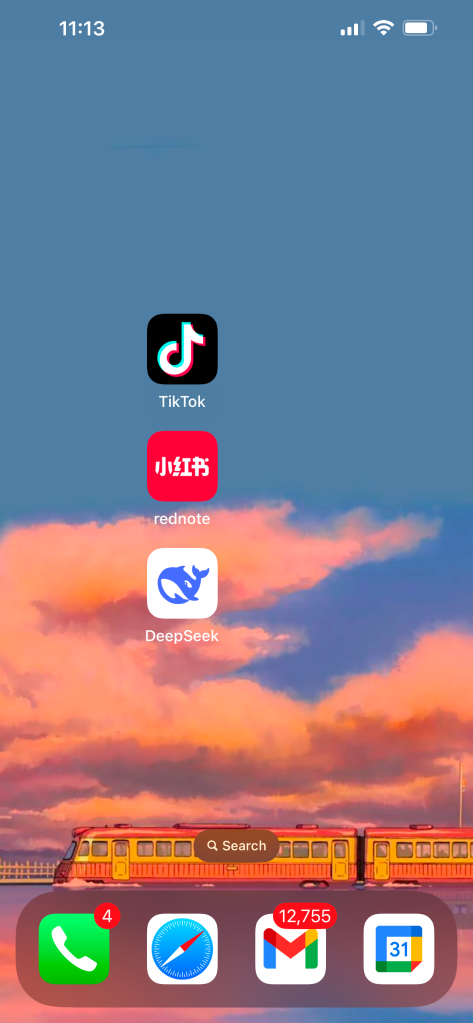
It’s been a crazy first month for China tech. I didn’t expect American TikTok refugees to migrate to Xiaohongshu/RedNote, aka the app that I spent the most time doomscrolling/reading reviews on (lol); didn’t expect DeepSeek—relatively unknown before January—to cause the biggest single-day market-cap drop ever, wiping out close to $600 billion for Nvidia; didn’t expect TikTok to once again narrowly avoid another ban in a Houdini-like escape; didn’t expect everyone to be talking about and embracing Chinese apps.
I think this unexpected resurgence points to several things: one, just how good Chinese tech has become; two, how even after so many years Silicon Valley and Wall Street are still frequently underestimating its appeal and progress; three, the appetite of the American public for good technology, regardless of its origin.
Talking about how ahead China is in its digital services is at this point an old story. From Unitree humanoid robots dancing Yangge at the Spring Festival Gala to super cheap driverless rides, from paying with your palm at the subway to drone food deliveries, it’s easy for these stories to get buried under a wider sense of malaise and stagnation. In New York, I’ve attended at least five talks on whether China is uninvestable/has peaked/losing soft power/lost its private sector vitality. But both these narratives can coexist and in a land this vast they indeed have.
Youth unemployment is high, the property slump is still underway, and last year’s GDP growth figure of 5% was widely met with disbelief by netizens. Yet even amidst all that there’s been pockets of vibrancy and flares of innovation, undeterred. RedNote and DeepSeek are perfect examples.
I wrote about the two in an op-ed in Fortune today, republished below. Welcome any thoughts and would love to discuss : ) Will also be in China in Feb — excited to be on the ground and experiencing the technology first-hand. As always, I know I’ll be surprised. xoxo
***
This article originally appeared on Fortune.com: https://fortune.com/2025/01/31/deepseek-rednote-tiktok-america-china-bans/
From TikTok to DeepSeek: America Needs to Outinnovate China, Not Ban Its Apps
We’re only a month into the new year and the most talked-about apps have been TikTok, RedNote, and DeepSeek. What’s remarkable is that they are all made by Chinese companies—the latest evidence that ostensible national security concerns won’t stop American users from flocking to Chinese apps.
What a twist. When TikTok became a global cultural phenomenon, many saw it as the exception, not the norm—most people outside China weren’t using Chinese apps (not even super app WeChat, which Facebook sought to imitate). But the popularity of RedNote and DeepSeek shows that Chinese tech companies remain hyper-competitive and haven’t stopped innovating.
Behind the Great Firewall, Chinese digital products have to constantly compete with each other for a slice of consumers’ mindshare and spending, which has spurred an incredible pace of imitation, iteration, and innovation. While China used to be seen as a copycat nation, it’s now the indisputable global leader in technologies like EVs, drones, and robots. TikTok exemplified what Chinese tech companies excelled at: design (the infinite scroll interface), functionality (how easy it was to create a video with background music), and most of all superb engineering (the addictive algorithm). Similarly RedNote’s success lies in its powerful internal search engine. Other Chinese apps that have made headway globally like Shein and Temu also built an edge with their cheap cost.
The same dynamic is now playing out in AI. Initial large language models out of China all aimed to replicate what ChatGPT could do and were deemed second-rate. But the launch of DeepSeek’s R1 model, which matched OpenAI’s o1 at a dramatically lower cost, upended the assumption. DeepSeek skyrocketed to the top free app in Apple’s App Store in the US (and 51 other countries), overtaking ChatGPT.
More small players will soon enter the fray with their own AI models, using DeepSeek’s training methods. And as AI models become more of a commodity, just like electricity, the differentiating factor comes from having a better cost structure, much like how China came to dominate other high-tech industries—from consumer electronics to solar panels. The US stock market panic on Jan. 27 and industry reactions of shock, awe, and paranoia point to that realization.
Yet, while the American public has enthusiastically embraced DeepSeek, policymakers are once again touting potential national security risks. Some of these concerns may have merit: the free chatbot self-censors when it comes to politically sensitive topics like Xi Jinping and Taiwan; user data is also stored in servers in China.
But this discourse, and how it echoes that of TikTok, is a troubling sign ofWashington embracing a techno-nationalist stance that’s increasingly insular—especially in an age of AI when diffusion is inevitable, and technological progress won’t be locked up behind paywalls and within centralized infrastructure. Should American policymakers go down the path of another nationwide ban (using the “Protecting Americans from Foreign Adversary Controlled Applications Act”), that sets the US on a dangerous slippery slope. America may end up banning any and all Chinese apps that gain traction among US users. And why stop at China? Fears of foreign manipulation will always exist as long as any country outside the US comes up with the next trendy app.
Such a protectionist posture is a reversal from the vision of openness, free expression, and vibrant competition that the US has long championed since the advent of the open web. Policymakers’ support of this vision now looks contingent—they champion open access when American tech companies are superior enough to maintain market dominance; but when other competitors emerge, they cite national security threats to keep them out. Instead of competing through innovation, the US is veering towards export controls, entity listings, and nationwide bans. That’s concerning because the country is ceding valuable opportunities to learn from and compete with apps emerging from outside its sphere of influence.While some argue that China has long banned US social media apps, and that this is merely tit-for-tat, it wasn’t too long ago that American tech executives and policymakers criticized China for its censorship apparatus. Washington taking a page out of Beijing’s playbook may lead to the US building a Great Firewall of its own.
There’s also a clear disconnect between lawmakers and the American public. When TikTok briefly went dark on Jan. 19, RedNote shot to the top of download charts in the US, becoming a haven for TikTok refugees who wanted to protest the government ban.
Like TikTok, DeepSeek’s success has created a rift between those who are invested in outcompeting China and those who benefit from affordable access to the best AI model. The fact that DeepSeek’s models are open-source—anyone can freely use, modify, and distribute their models, unlike closed, proprietary models built by OpenAI and Anthropic—fly in the face of arguments that the Chinese company is undermining American innovation.
Banning Chinese apps may boost US alternatives in the short term, but in the long run it also risks isolating America from breakthroughs elsewhere. To reach superintelligence first, America needs to outcompete and outinnovate China by accelerating innovation, enhancing market competition, and adopting new efficiencies —not by restricting access and building monopolies at home.


Leave a Reply