
I remember Dali by its steps. On that Wednesday, we climbed and climbed. At eleven in the morning, we stood at the bottom of the Cang Shan (苍山), the sacred mountain that’s the backdrop to Dali — a land as surrealist as its name.
Our destination? A Buddhist nunnery called Ji Zhao An (寂照庵), sometimes called the most beautiful nunnery in China for its unique medium of worship — in place of incense sticks were flowers and succulents, dotting the altars and eaves. Now it was viral online for a whole other reason: its vegetarian lunch (斋饭), 20 yuan per pax; reviews raved about how good it was.
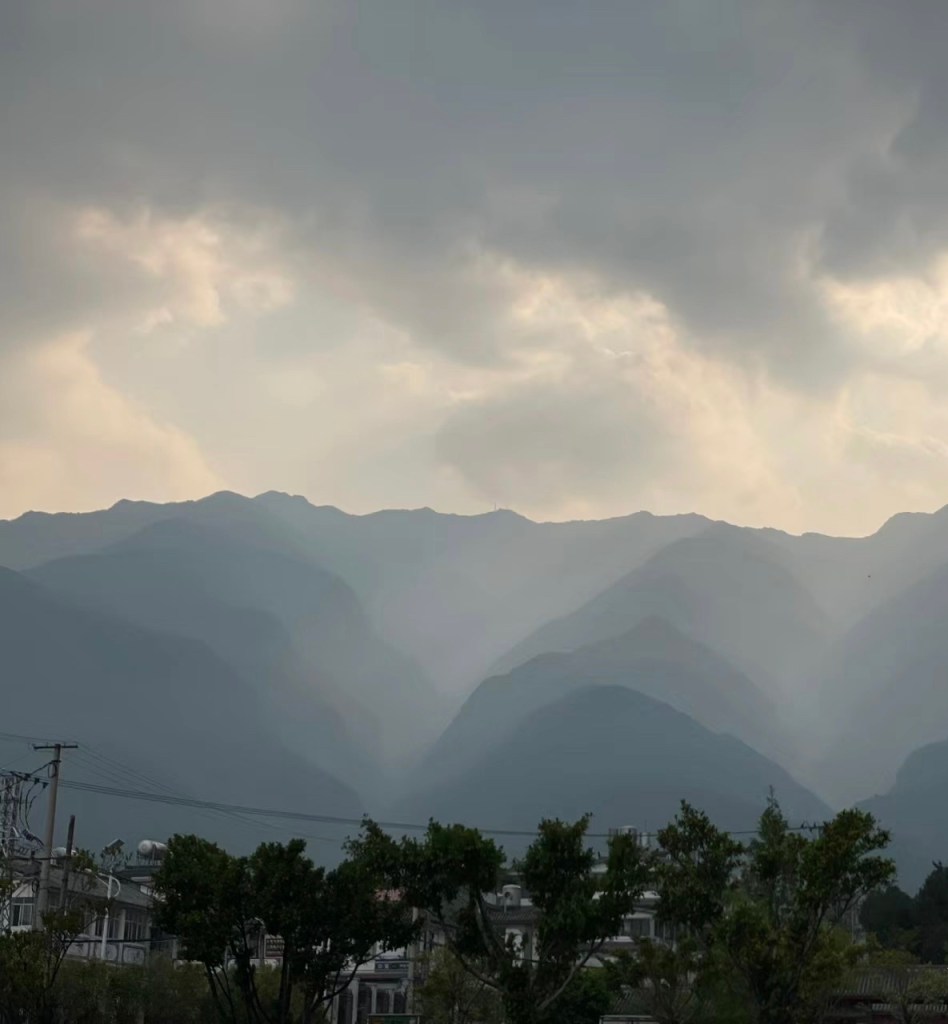
We started our way up the steps, along a cobble-stoned path, then onto a wide, winding road that wrapped around the mountain like a rope. On Google Maps the route said five minutes, easy peasy — the reason why my mom and I were in platform sneakers instead of running shoes.
At first the day was all crisp air, gorgeous green, dappled sunlight. But after fifteen minutes, my legs started feeling leaden — and we were absolutely nowhere near. The blue dot marking our location was so far off the mark we might as well be floating above the mountain.
With each step the air felt thinner (we were about 2000 meters above sea level) and I popped a Ricola candy into my mouth, the spurt of sweetness fading far too fast to pierce the faintness. A group of hikers trickled in our direction as I stood, hands on knees, panting like a rhino.
“How long more to Ji Zhao An?” I asked one uncle.
“A long way!”
My mom and I shared a look of utter panic.
“This way is way faster.” The uncle pointed away from the main road to a barely visible steep flight of stone steps disappearing behind the foliage. “But harder.”
“Uh never mind,” I quickly said. “We’ll take the long way.”
The uncle tsk-tsked. “By the time you get there, lunch would’ve run out with how long the queue is.” He seemed personally affronted by my physical ineptitude. “Young lady, you must challenge yourself.”
We stared at each other like two black-eyed peas.
“Go! What are you standing here for?” he barked.
My mom made a shoo motion and, with dread knotting in my stomach, I began my tepid ascent. The food, the food. It was all I could concentrate on to move one leg before another. I was so unfit I felt like any older auntie could outstride me in a heartbeat.
Far behind my mom yelled leisurely, “Get in line! I’ll come find you.”
I’d woken up at eleven and still haven’t had breakfast. My stomach growled and I dreamt in technicolor of vegetables. The steps stretched out before me in never-ending sequence. Then suddenly I heard the sweet, sweet cacophony of raucous human voices. I stopped at crossroads, where a man was sitting on a mat doing nothing.
“Nunnery…where?” I croaked.
He stared at me dubiously and pointed left. I felt a wave of energy surge within my piteous legs at the thought of lunch — imminent at last — and sprinted.

Twenty minutes later, on a wooden bench in an airy atrium, digging into a bowl full of pumpkin, eggplant, carrots, fermented tofu, lotus roots, spicy cabbages and fragrant white rice (silently dispensed to me by nuns in gray robes), I truly felt like I was feasting on earth’s riches. Vegetables, love of my life! The torturous hike was rewarded, my hunger soothed with each bite, even the taste of rice lingered after days of carb-less diets. I even had a second serving.

Food was sustenance, blunt and clean. There was no molecular gastronomy, delicate textures, or coddling of your palate like in fine dining. But I felt more cleansed and renewed than at any Michelin-starred restaurant.

The point, I was starting to realize, was the climb. The faith accrues in the act of exertion. The motley of monasteries on this mountain were all somewhere up, hidden in the trees and away from the hongchen, or ‘red dust’ — worldly defilements. The ascent was a necessary part of the pilgrimage, as much a test as it’s a rite to strip your mind of the inessential, to lull it into the meditative energy of constancy: one foot before another, one step at a time. In the right frame of mind, one enters a temple differently. I felt mortal and aware of my mortality, startling in its hunger and weakness. Humbled. On the walls, the platitudes written in calligraphy (which I usually glaze over when I see them in offices) made sense.


 Selina Xu
Leave a comment